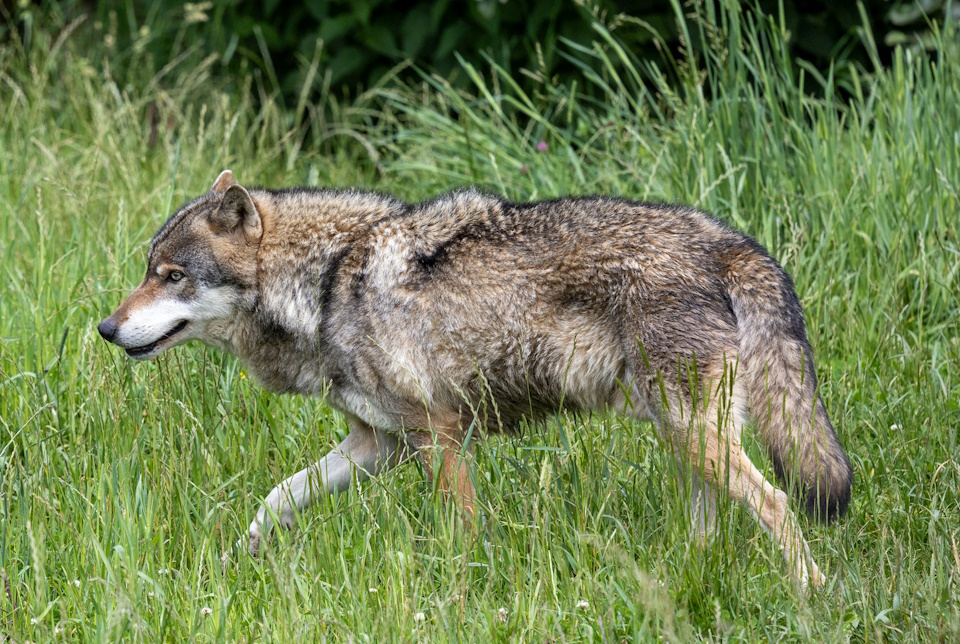
WDFW has removed an adult male and female wolf from the southeast Washington pack in less than two weeks after repeated cattle depredations continued despite nonlethal deterrence efforts.
The Washington Department of Fish and Wildlife has killed a second wolf from the Couse Pack in southeast Washington as wildlife managers attempt to stop a months-long pattern of attacks on livestock.
The latest removal follows a series of confirmed and probable wolf depredations in Asotin County and marks a significant escalation in management of the Couse Pack. Earlier this year, WDFW declined to authorize agency lethal removal, but continued livestock losses ultimately led the department to change course.
Two Wolves Removed in September
WDFW first authorized incremental lethal removal from the Couse Pack territory in September following another confirmed livestock depredation on Sept. 8.
On Sept. 17, WDFW staff killed an adult male wolf. The department then paused lethal action to evaluate whether removing the wolf would change the pack’s behavior.
It did not end the conflict.
On Sept. 23, WDFW investigated an injured calf and determined that its injuries were consistent with wolf depredation. According to the department, that was the second confirmed depredation event in the Couse Pack territory within 30 days and the seventh event within 10 months.
WDFW Director Kelly Susewind subsequently authorized additional incremental lethal removal on Sept. 28. By that point, WDFW had documented four confirmed livestock deaths, one probable livestock death and two confirmed injuries involving two livestock producers in Asotin County.
An adult female wolf was then killed on Sept. 30.
WDFW has again stopped lethal action while staff evaluate whether the latest removal changes the pack’s behavior. The Couse Pack was originally confirmed as a pack in 2023.
Conflict Began Earlier in 2026
The current situation developed over several months.
On Feb. 19, WDFW confirmed that a wolf had injured a calf in Couse Pack territory. Two calves were confirmed killed in separate incidents on March 16 and March 17, followed by a probable wolf kill on April 1.
On April 3, WDFW confirmed that an adult cow had been killed by wolves. During that same incident, an employee of the affected livestock producer shot and killed a wolf while it was attacking cattle.
Because the Couse Pack is located in the federally delisted portion of eastern Washington, state law allows a livestock owner or authorized employee to kill a wolf caught in the act of attacking livestock under specific circumstances.
Despite the series of attacks, Susewind declined to authorize additional agency lethal removal in April. At that time, WDFW noted that the wolf killed during the April 3 incident had already reduced the pack by one animal, and the department chose to evaluate whether that would reduce future conflict.
By September, however, depredations had resumed.
Ranchers Had Been Using Nonlethal Deterrents
WDFW’s decision did not come immediately after the first livestock loss.
According to the department, affected producers had been using several measures intended to reduce the chance of wolf conflicts. These included daily or near-daily range riding and human presence, delaying the turnout of calves until they weighed more than 200 pounds, avoiding areas with high wolf activity when calves were smaller, and removing sick or injured livestock from grazing areas.
After the Sept. 23 attack, WDFW concluded that additional reactive nonlethal deterrents were not appropriate for the situation and that depredations were likely to continue without a change in pack behavior.
The department describes its strategy as incremental lethal removal rather than elimination of the entire pack. Wolves are removed and the department then pauses to determine whether the remaining animals change their behavior.
Washington’s Wolf Population Is Still Growing
The Couse removals are taking place against a much broader recovery of wolves across Washington.
At the end of 2025, WDFW and tribal wildlife managers documented a minimum of 270 wolves in 49 packs, including 23 successful breeding pairs. That represented a 17.4% increase from the previous year’s minimum count of 230 wolves and was Washington’s highest minimum wolf count since wolves began naturally recolonizing the state.
Washington’s first modern resident breeding pack was documented in 2008. Since then, wolves have expanded across much of eastern Washington and into portions of the North Cascades. However, recovery remains geographically uneven, and no packs or breeding pairs were documented in the Southern Cascades and Northwest Coast Recovery Region at the end of 2025.
That geographic difference remains important in the debate over how wolves should eventually be managed.
Wolves Are Not Open to General Hunting in Washington
Hunters should also understand that WDFW’s removal of Couse Pack wolves does not mean Washington has opened a wolf hunting season.
Gray wolves remain classified as endangered under Washington state law throughout the state, which generally prohibits hunting or killing them.
Federal status differs geographically. Wolves are federally delisted in roughly the eastern third of Washington, including the area east of Highway 97, Highway 17 and Highway 395 as defined by federal boundaries. Wolves in the western two-thirds of Washington remain federally protected under the Endangered Species Act.
Agency removal of wolves involved in repeated livestock depredations is therefore a wildlife-management action conducted under Washington’s Wolf Conservation and Management Plan and Wolf-Livestock Interaction Protocol — not recreational hunting.
Wolf Management Remains a Major Issue for Washington Hunters
Washington’s growing wolf population continues to create one of the state’s more difficult wildlife-management debates.
Livestock producers and many hunters have pushed for greater management flexibility as wolf numbers and distribution increase, particularly in eastern Washington. Conservation organizations, meanwhile, have emphasized that wolf recovery remains incomplete across much of western Washington and have scrutinized lethal-control decisions.
For hunters, wolves are also part of the broader discussion about management of deer, elk and other ungulates. However, the Couse Pack removals themselves are specifically a response to documented livestock depredations, and WDFW has not characterized these removals as an action intended to increase deer or elk populations.
For now, the department will watch the remaining Couse wolves to determine whether removing the adult male and female ends the livestock conflict. If additional depredations occur, WDFW could again consider further lethal action.
Hunters interested in following the situation can find the latest Couse Pack information and other wolf-management actions on the WDFW Washington wolf updates page.
Stay Informed With Hunterizer
Predator management, changing wildlife populations and location-specific regulations can make it difficult for hunters to keep track of what applies where they hunt. The Hunterizer app helps hunters quickly see what species are open at their location and on a particular date, along with season dates, hunting zones, legal weapons, bag limits, shooting hours and other important regulations.
As Washington’s hunting seasons continue this fall, use Hunterizer to check what is legally open where you’re hunting — and always remember that wolves remain protected from general hunting in Washington.