Montana Fish, Wildlife & Parks is warning residents and hunters about another detection of Rabbit Hemorrhagic Disease Virus 2 (RHDV2) after three feral domestic rabbits in Yellowstone County tested positive for the disease.
The rabbits came from a feral population living on the Rocky Mountain College campus in Billings. College staff began finding multiple dead rabbits in late July, and three carcasses were submitted to the FWP Wildlife Health Lab in Bozeman. All three tested positive for RHDV2.
While the latest cases involve feral domestic rabbits rather than hunter-harvested wild rabbits, RHDV2 is important for Montana hunters because the virus can infect wild rabbits and hares as well.
RHDV2 Is Not New to Montana
This is not Montana’s first encounter with the disease.
RHDV2 was first detected in Yellowstone County in 2021 and has subsequently been detected in rabbits in several additional Montana counties. The virus has become an emerging wildlife-disease concern across much of the western United States.
RHDV2 affects lagomorphs—the group that includes rabbits, hares and pikas. Montana FWP lists several native species as susceptible, including black-tailed jackrabbits, white-tailed jackrabbits, eastern, mountain and desert cottontails, pygmy rabbits, snowshoe hares and American pikas.
The disease can spread extremely efficiently. Infected animals shed the virus through urine, feces and respiratory secretions. Transmission can occur directly between animals or indirectly through contaminated food, water, bedding, cages, clothing, footwear and other surfaces. Scavengers may also spread infected carcass material.
Of particular concern is the virus’s ability to remain infectious in the environment. FWP says RHDV2 can survive for as long as 15 weeks under dry conditions and can survive freezing temperatures.
What Does RHDV2 Look Like?
Often, there isn’t much warning.
Sudden death is one of the most common outcomes. An infected rabbit or hare may die before a hunter or landowner notices anything unusual.
When symptoms do occur, they can include fever, lethargy and loss of appetite. Dead animals can appear outwardly normal, although some may have bloody discharge around the nose or face.
Importantly, RHDV2 is not known to infect humans or non-lagomorph animals. However, hunters should not assume that every dead or sick rabbit has RHDV2. Rabbits can carry other diseases that are capable of infecting people, which is why abnormal or already-dead rabbits should still be treated cautiously.
Rabbits and Hares in Montana
Montana has surprisingly diverse rabbit and hare populations.
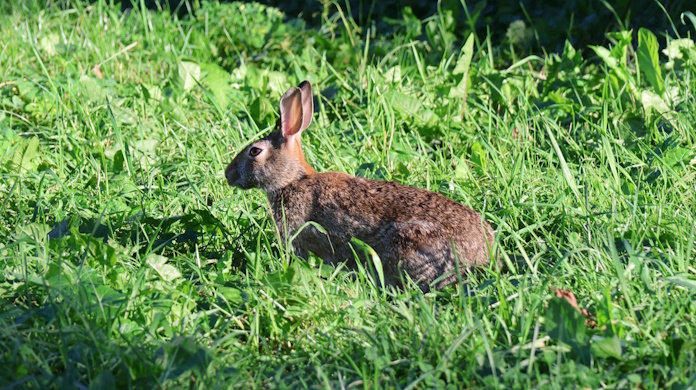
FWP identifies eight members of the rabbit family in the state: eastern cottontail, mountain cottontail, desert cottontail, pygmy rabbit, snowshoe hare, white-tailed jackrabbit, black-tailed jackrabbit and American pika. Some have relatively limited distributions and are uncommon across much of Montana.
For hunters, cottontail rabbits and snowshoe hares are among the primary small-game opportunities, with hunting available year-round under Montana’s nongame rules. Unlike Montana’s tightly structured big-game seasons, rabbit and hare hunting can therefore provide an opportunity outside the traditional fall hunting calendar. Hunters should still check current FWP regulations, land-specific restrictions and license requirements before heading out.
Cottontails are generally associated with brushy cover, agricultural edges, draws and areas providing a combination of food and escape cover. Snowshoe hares are much more closely associated with forested habitats and dense understory, particularly in western and mountainous Montana.
Montana also has both white-tailed and black-tailed jackrabbits. Despite their name, jackrabbits are actually hares. White-tailed jackrabbits are particularly impressive animals, reaching roughly two feet in length and commonly weighing 6 to 10 pounds.
The state’s pygmy rabbit and pika populations are also susceptible to RHDV2, making the disease a broader wildlife-management concern than simply its effect on huntable rabbit populations.
What Montana Rabbit Hunters Should Do
The Yellowstone County detection isn’t a reason for hunters to stop pursuing rabbits and hares, but it is a reason to pay closer attention in the field.
Hunters should watch for areas containing multiple dead rabbits or hares, particularly when there is no obvious explanation for the mortality. An unusual cluster of dead animals should be reported rather than handled unnecessarily.
FWP specifically asks people who discover feral or wild rabbit carcasses in an area to report the event to their local FWP office or the FWP Wildlife Health Lab at 406-577-7880 or 406-577-7882.
If a rabbit carcass in Yellowstone County must be disposed of, FWP recommends wearing disposable gloves, double- or triple-bagging the carcass, disinfecting the outside of the bag when possible, disposing of it through a landfill-bound dumpster and washing hands afterward. FWP recommends a solution of ½ cup of bleach per gallon of water with five minutes of contact time for disinfecting contaminated areas, while noting that the solution is corrosive.
Hunters should also avoid transporting suspicious carcasses or rabbit parts unnecessarily. Boots, clothing and equipment can potentially carry contaminated material from one location to another.
Don’t Confuse RHDV2 With Deer Hemorrhagic Disease
The name can also cause some confusion among hunters.
Rabbit Hemorrhagic Disease is not the same disease as Epizootic Hemorrhagic Disease (EHD) that Montana hunters commonly associate with white-tailed deer.
RHDV2 primarily affects rabbits, hares and pikas and can spread through direct contact and contaminated materials.
EHD and the closely related bluetongue virus primarily affect animals such as white-tailed deer and are generally transmitted by biting midges. Montana has experienced EHD and bluetongue outbreaks, particularly east of the Continental Divide, with outbreaks typically appearing during late summer and fall before freezing temperatures reduce midge activity.
The similar terminology can make the diseases sound related from a hunter’s perspective, but they involve different viruses, hosts and transmission pathways.
What This Means for Montana Hunters
For now, the Yellowstone County cases represent a wildlife-health warning rather than a change to Montana hunting seasons.
Rabbit and hare hunters should continue to follow current Montana regulations, but they can also serve as an important early-warning network. Hunters spend time in habitat and locations where wildlife managers cannot continuously monitor populations. Finding several freshly dead rabbits or hares in the same area—especially animals without obvious trauma—is worth reporting.
RHDV2 has already demonstrated that it is established in Montana, and the latest Billings cases are another reminder that the disease remains on the landscape.
Hunterizer Takeaway
The recent Yellowstone County cases don’t mean Montana hunters need to abandon rabbit or hare hunting. They do mean hunters should know what RHDV2 is and avoid handling animals that are already dead or obviously sick.
If you encounter an unusual number of dead rabbits or hares, don’t move the carcasses to another area and report the mortality to Montana FWP.
For hunters pursuing cottontails, snowshoe hares and other small game, Hunterizer can help keep current Montana hunting seasons, regulations and species information together in one place before heading into the field.
Check Montana Seasons with Hunterizer
If you’re heading out for rabbits, hares, or other small game in Montana, Hunterizer makes it easier to know what you can legally hunt at your location and on a particular date.
The Hunterizer app brings Montana hunting seasons and regulations together in one place, including season dates, legal methods, hunting hours, bag limits, licensing requirements, and other species-specific rules. Instead of digging through multiple regulation documents, hunters can quickly check what’s open before heading into the field.
With wildlife issues such as RHDV2 also affecting species hunters encounter, knowing the regulations is only part of being prepared. Pay attention to unusual wildlife mortality, report suspicious rabbit or hare deaths to Montana FWP, and use Hunterizer to stay on top of the hunting rules for your next trip.
Know what you can hunt today. Hunt informed with Hunterizer.